 CIRCT
CIRCTTools
CIRCT includes a number of existing tools which can be combined and or extended to help develop your own custom EDA flows.
Front-End Tooling
TODO Overview
Synthesis Tooling
TODO Overview
Formal Verification Tooling
Formally verifying hardware designs is a crucial step during the development process. Various techniques exist, such as logical equivalence checking, model checking, symbolic execution, etc. The preferred technique depends on the level of abstraction, the kind of properties to be verified, runtime limitations, etc. As a hardware compiler collection, CIRCT provides infrastructure to implement formal verification tooling and already comes with a few tools for common use-cases. This document provides an introduction to those tools and gives and overview over the underlying infrastructure for compiler engineers who want to use CIRCT to implement their custom verification tool.
The below diagram provides a visual overview of the passes and dialects available to support development of verification tools.
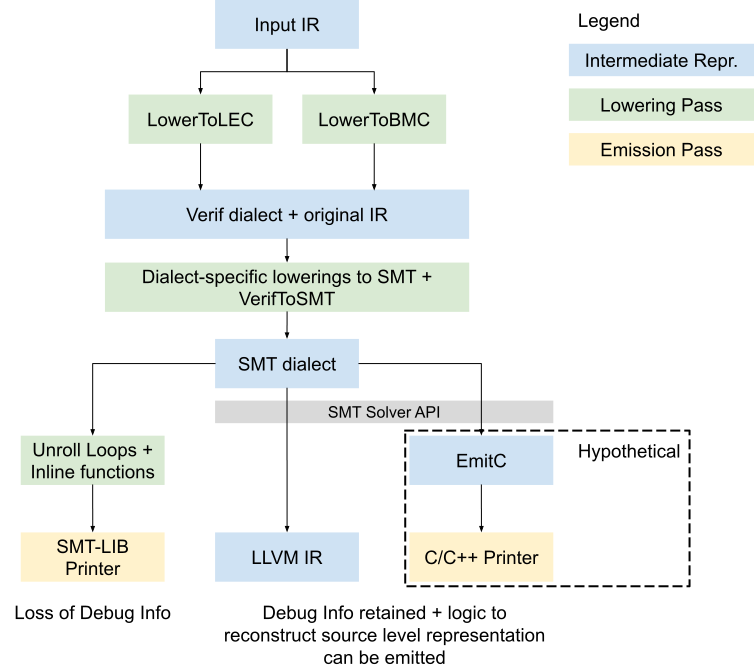

The overall flow will insert an explicit operation to specify the verification
problem (e.g., verif.lec, verif.bmc). This operation could then be lowered
to an encoding in SMT, an interactive theorem prover, a BDD, or potentially
be exported to existing tools (currently only SMT is supported). Each of
those might have their own different backend paths as well. E.g., an encoding in
SMT can be exported to SMT-LIB or lowered to LLVM IR that calls the Z3 solver.
Existing tools include a logical equivalence checker and a bounded model checker. We discuss extensions to each ofthese in their respective documentation.