esiaccel.types.AnyType Class Reference
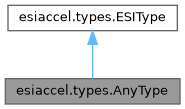
Inheritance diagram for esiaccel.types.AnyType:
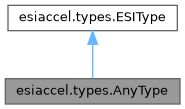
Collaboration diagram for esiaccel.types.AnyType:
Public Member Functions | |
| __init__ (self, str id) | |
| Tuple[bool, Optional[str]] | is_valid (self, obj) |
| bytearray | serialize (self, obj) |
| Tuple[object, bytearray] | deserialize (self, bytearray data) |
| Public Member Functions inherited from esiaccel.types.ESIType | |
| __init__ (self, str id) | |
| wrap_cpp (cls, cpp.Type cpp_type) | |
| str | id (self) |
| Tuple[bool, Optional[str]] | supports_host (self) |
| int | bit_width (self) |
| int | max_size (self) |
| int | __hash__ (self) |
| bool | __eq__ (self, other) |
| str | __str__ (self) |
Additional Inherited Members | |
| Public Attributes inherited from esiaccel.types.ESIType | |
| cpp_type = cpp_type | |
| str | id |
| Protected Member Functions inherited from esiaccel.types.ESIType | |
| _init_from_cpp (self, cpp.Type cpp_type) | |
Detailed Description
Constructor & Destructor Documentation
◆ __init__()
| esiaccel.types.AnyType.__init__ | ( | self, | |
| str | id ) |
Definition at line 190 of file types.py.
References esiaccel.types.ESIType._init_from_cpp().
Member Function Documentation
◆ deserialize()
| Tuple[object, bytearray] esiaccel.types.AnyType.deserialize | ( | self, | |
| bytearray | data ) |
Convert a bytearray to a Python object. Return the object and the
leftover bytes.
Reimplemented from esiaccel.types.ESIType.
◆ is_valid()
| Tuple[bool, Optional[str]] esiaccel.types.AnyType.is_valid | ( | self, | |
| obj ) |
Is a Python object compatible with HW type?  Returns either '(True,
None)' if it is, or '(False, reason)' if it is not.
Reimplemented from esiaccel.types.ESIType.
◆ serialize()
| bytearray esiaccel.types.AnyType.serialize | ( | self, | |
| obj ) |
Convert a Python object to a bytearray.
Reimplemented from esiaccel.types.ESIType.
The documentation for this class was generated from the following file:
- /home/runner/work/circt-www/circt-www/circt_src/lib/Dialect/ESI/runtime/python/esiaccel/types.py
Generated on for CIRCT by
 1.15.0