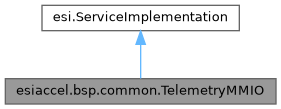
Inheritance diagram for esiaccel.bsp.common.TelemetryMMIO:
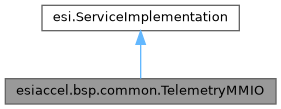
Collaboration diagram for esiaccel.bsp.common.TelemetryMMIO:
Public Member Functions | |
| bool | generate (ports, esi._ServiceGeneratorBundles bundles) |
Static Public Attributes | |
| clk = Clock() | |
| rst = Reset() | |
Detailed Description
An ESI service implementation which provides telemetry data through an MMIO
region. Each client request is assigned a register in the MMIO space. When a
read request is received for the assigned address, it gets routed to the
assigned client. When a write request is received, it is discarded. The
assignment table is stored in the manifest.

**REQUIREMENTS.** Both are needed to make the response merge safe:

1. The `MMIO` service implementation this connects to must not issue a read
   command while a previous read's response is still outstanding.
2. Every telemetry client must assert its `data` channel's `valid` only in
   response to a `get`. `Telemetry.report_signal` does this; a client which
   holds `valid` high permanently -- legal ESI, and the natural way to
   express an always-available counter -- does not.

Given both, each command is demuxed to exactly one client and at most one
client is offering a response at a time, so the responses can be merged with
`ChannelMergeOneValid` instead of arbitrated -- which keeps the response path
from building a combinational cone across every telemetry client.

Nothing here enforces either, and violating either loses responses. Note (2)
is not specific to this merge: `ChannelMux2` is fixed-priority, so under an
arbiter a permanently-valid client starves every client behind it.
Member Function Documentation
◆ generate()
| bool esiaccel.bsp.common.TelemetryMMIO.generate | ( | ports, | |
| esi._ServiceGeneratorBundles | bundles | ||
| ) |
Member Data Documentation
◆ clk
|
static |
Definition at line 801 of file common.py.
Referenced by esiaccel.bsp.common.ESI_Manifest_ROM_Wrapper.build().
◆ rst
The documentation for this class was generated from the following file:
- /home/runner/work/circt-www/circt-www/circt_src/lib/Dialect/ESI/runtime/python/esiaccel/bsp/common.py